Showing posts with label boxer. Show all posts

Monday, February 25, 2008

How Am I Supposed to Know?' 10 Things About My Dad (#3)

Here's the 'When We Last Saw Our Hero' catch-up: During a TV show set in Kentucky, I asked daughter #2 who was born in Kentucky, and she just shrugged. When I exasperatedly told her that my dad was born in Kentucky, she just as exasperatedly questioned, 'How am I supposed to know anything about him?' So I'm scribbling down 10 things for her to know about my dad. I posted Number One and Number Two earlier.

Number Two Postscript
I'm 6' 1" and usually around 210 pounds, which is about two inches shorter than Mohammed Ali and right in the middle of his range of fighting weight. After my last post, someone described my dad as 'larger than life,' and I laughed. He was 5' 8" and probably weighed 150-160 pounds most of his adult life. Even at that size, when we'd watch Ali, Joe Frazier, Sonny Liston and all the other heavyweight boxers, he'd tell me that he could take them all. And maybe with my height and my heavyweight bulk, he could've. Or, if you read my last post, you'd know that he would've at least made it entertaining.


Number Three
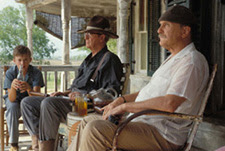
My dad's the one on the right, and nobody knows who Kelley is except that the two of them celebrated V.E. Day (Victory in Europe, ending World War II in Europe). He joined the Coast Guard in 1939 in St. Louis, Missouri, before the United States entered the war, and told me that he enlisted when he saw a poster of a ship-to-ship rescue. He later mentioned an additional sense of urgency to his enlistment.

Prior to joining the Coast Guard, my dad worked as a truck driver, delivering ice to homes and businesses in Western Kentucky. I'd like to think that patriotic duty and the lure of adventure on the open seas drew him to the Coast Guard . . . but the real story seems to involve speeding along a dark roadway, skidding the ice truck on its side around a curve and his sneaking away to St. Louis.

During the war, he became a Chief Petty Officer in the engine room of a frigate, the Tallapoosa, escorting convoys in and out of North Africa. He also spent time in Alaska's Aleutian Islands.

His stories of World War II were always funny. One of the best occurred during shore leave in Oran, Algeria, when an Algerian military policeman stopped a truckload of his shipmates. A buddy of my dad's stepped out of the back of the truck, assuring them that he'd handle it. He casually walked up to the soldier looking eager to improve international relations, then knocked him out with one punch and returned to the party in the back of the truck (I later saw this same episode in a movie, but you have to believe your dad).

My dad showed me how he cooked 'Frog in a Hole,' atop a diesel engine. It's an egg and toast combination that I passed on to my kids and that daughter #1's friends love for her to cook. He talked of friends and wild antics that made me believe that he loved his military days.

During my senior year in high school, I began recognizing the signs that our family really didn't have the money to send me to college. At the time, I wanted to go to the University of Texas, like my cousin Jack, and eventually become an architect.

I knew that my dad loved his days in the Coast Guard, so I stopped by the Navy recruiter's trailer in Port Arthur's Jefferson City Shopping Center. This was a major step for me because the Vietnam War had ended just a couple of years earlier; and I'd spent most of my junior high and high school life scared to death of being drafted and hauled off to a place that I understood only by the nightly news score cards (we always won, killing and wounding more of them than they killed and wounded of us).

I told the recruiter that I'd like to be an architect and that I'd heard the Navy would pay for me to go to school. He assured me that the Navy would pay for me to go to school to become an engineer, which he told me was pretty much the same thing.

Brochures in hand -- probably featuring photos of a '70s version of a ship-to-ship rescue -- and expecting elation from my dad, I excitedly told him and my mom of my plans. His only response was, 'Don't worry. We'll find a way to pay for college.'

I was shocked and didn't understand until about 10 years later, when my dad checked into an alcoholic recovery unit. My older sister and I had never experienced any kind of abuse, neglect or embarassment because of his drinking, so this took us as a HUGE surprise.

He was out of his room, when I arrived for a visit, and I picked up a handwritten note off his night stand. When I asked about the note, he told me that patients in the unit talked in groups about their addiction-related issues, then wrote letters of encouragement to whoever spoke during that session.

This letter said something like: 'George, I know it must have been awful for you during the war to see men burning in the water, screaming for help, and you couldn't do anything.'

A German submarine had sunk a ship in his convoy, trapping its crew and passengers in a sea of burning oil and diesel fuel. His dreams of an exciting ship-to-ship rescue had become a decades-long nightmare.

I don't think I'm ready to share all of Number Three with daughter #2. In her very sweet, caring way, she'd ask, 'Hey, buddy. What's wrong? Why are you crying?'

Thursday, February 21, 2008

'How Am I Supposed to Know?' 10 Things About My Dad (#1 and #2)


This is my dad. This photo is one of my best photos. I took it in the late '70s, and it's been around our house for decades. I think it captures my dad perfectly, in appearance, character and personality, although I did have loan him the hat for full effect.

I'm telling you about this photo and introducing you to my dad because of daughter #2. She shocked me last weekend when we were watching Extreme Makeover: Home Edition (our family's weekly sniff-and-feel-good-about-people time together). The show took place in Louisville, Kentucky.

When I asked daughter #2 who was born in Kentucky, she just shrugged. When I exasperatedly told her that my dad was born in Kentucky, she just as exasperatedly questioned, 'How am I supposed to know anything about him?' He died when daughter #2 was less than 2 years old.

So, here are 10 things about my dad (in no order of importance . . . forgive me if I've already shared some of this with you) that I'll share with daughter #2.

Number One
He was born August 6, 1916 in Dukedom, Tennessee, and grew up in Mayfield, Kentucky, which is in Western Kentucky, and was a teenager during the Great Depression. He was the youngest in his family and had two older sisters -- Kathleen and Ruby -- and an older brother Herman.

Aunt Kathleen and Aunt Ruby visited Texas when I lived in Conroe in the early '80s. My parents drove them over from Port Arthur, and I still laugh when I think of them calling my dad, then nearly 70 years old, by his childhood name: 'Baby.'

Number Two
My dad was a boxer in his teens and 20s. He told me that he was a Golden Gloves boxer, but most of the stories I heard were about his matches when a carnival came to Mayfield or nearby Paducah, Kentucky. Carnivals were traveling shows that moved from town to town during the Depression; and their games, contests, shows and exotic animals were the most excitement a little town like his would see for months.

Some carnivals featured a 'champion' boxer, and when the carnival hit town, word spread quickly (and tickets sold just as quickly) that this champion would box and beat 24 of the 'best' local boxers in 24 hours. My dad usually was one of those 24 boxers; and during the Depression, when jobs and money were hard to come by, he was happy to look good for a few rounds, take a few punches, hit the mat, and then pick up his paycheck from the champ's manager.

He must've been a local favorite because other carnivals recruited him for their Thursday-through-Saturday, best-of-three matches. From what I understand, he always lost on Thursday, but made a valiant, underdog comeback on Friday. Tickets sales 'skyrocketed' (as much as tickets sales would skyrocket in a small town) for Saturday's championship bout; and almost always, he lost after a 'hard-fought' match. And then he picked up his paycheck from the champ's manager.

My dad was 'older' -- 39 -- when I was born (I was 42 when daughter #2 was born, so I laugh when I think about it), but he was very quick when he'd box with the neighborhood boys in his 50s and even when he'd shadow box in his 60s.

I don't think I appreciated just how quick he was until he shared with me how he and a World War II shipmate (he was in the Coast Guard, which was rolled into the Navy during the war) would pick up a few bucks before shore leave. My dad would pull his handkerchief out of his pocket, lay it on the ground and stand on it with both feet. His friend would take bets: my dad would remain standing on the handkerchief and any challenger could try to hit in the head. The story, as told to me, was that he never got hit; however, his ears sure were cauliflowered (a sure sign that a boxer has taken some hits -- could've been from all those carnival losses).

There does seem to be common thread of boxing and money running through all his stories.

My dad gave me two bits of boxing/life advice:
- You gotta roll with the punches (which, at 52, I finally realize is true)
- You gotta bob and weave (a skill to which he attributed his handkerchief-bet winnings)

He tried to teach me how to box, but I was slow, skinny and not very strong. And I weaved and bobbed when I should've bobbed and weaved.

When I was about 13 or 14, we were boxing in the front yard (can you imagine today's response to a father and teenage son fighting in the front yard?). He hit me upside the head with a right cross and floored me. Like most teenage boys, I sprang up wildly, and I caught him by surprise with a right hook in the side. After several days of soreness, he went to the doctor, who told him that he had a couple of broken ribs.

And I think that became Chapter One in his unwritten, unplanned Lessons for Fatherhood. Even with fascinating recollections of carnivals and ship-board bets, that front-yard match and those broken ribs became his most-often repeated boxing story for the next couple of decades.

Daughter #2's going to have to wait for Things to Know About My Dad #3-10.

Monday, December 3, 2007

A Pirate Legacy

Yes, I am a pirate, 200 years too late
The cannons don't thunder, there's nothing to plunder
I'm an over-40 victim of fate, arriving too late, arriving too late
- - A Pirate Looks at 40 as sung by Jimmy Buffett

A Pirate Looks at 40 is one of my all-time favorite songs; and, even though I've been on the straight and narrow most of my life (okay, all of my life . . . I'm pretty dull), I'm still waiting, at the drop of an eye-patch, to pick up a cutlass and plunder the nearest frigate.

Just like almost any kid, I thought my parents were the dullest people I'd ever met. Now that I know how dull children can make you, maybe, as Buffett sings, . . . it could me my own damn fault.

BUT I do think there are hints of a pirate legacy in family . . .

My dad cited his first taste of alcohol as a young kid in Kentucky eating sugar from the bottom of moonshine stills (gee, dad. wasn't that illegal?).

As a boxer, he often took on the 'champion' from whatever carnival might be passing through Mayfield (and probably Paducah). Except he knew that he would take the fall on Thursday, but then he'd be able to beat the champ on Friday, which, of course, set up the sell-out for Saturday night (the champ alway won in the ring, but my dad had money in his pocket).

My mother was eating a hamburger and fries in a Port Arthur cafe, when a would-be suitor plopped down in the booth across from her. As he talked, he reached for French fry, and she warned him not to touch her French fries. He laughed and reached for another fry. My mom, in her own swashbuckling way, swiped her knife off the table and stabbed the back of his hand . . . 'I told you not to touch my French fries.'


After my parents married and my dad went to work at Texaco in Port Arthur, his friends warned him the Cajun women sleep with knives under their pillows. He believed.

Role Models